In my last post, I summarized what the Supreme Court of Canada had to say about constitutional interpretation in Taylor v Newfoundland and Labrador, 2026 SCC 5. I suggested that the case could have been decided by a careful reading of the text, or at least the two texts, English and French, of the Canadian Charter of Rights and Freedoms. But no judge took this view: they all had a great deal to say about interpretation that was not limited to reading constitutional text. This is what this post addresses, arguing that the majority opinion, in particular, is pernicious.
By way of reminder, Taylor concerned the existence of a right to interprovincial travel (otherwise than to work to take up residence) under section 6 of the Charter. All the judges concluded that there was such a right, but they disagreed about why. There are three opinions: the majority one written by Justices Karakatsanis and Martin (with whom Justices Côté, O’Bonsawin, and Moreau agreed), and two others, labelled as partial dissents despite being concurrences in judgment — one by Justices Kasirer and Jamal (with whom the Chief Justice agrees), and the other by Justice Rowe.
All three profess fidelity to purposive interpretation. But, in keeping with the divisions on the Supreme Court in cases such as Quebec (Attorney General) v 9147-0732 Québec inc, 2020 SCC 32 (which I have discussed in detail in an article), there is no real agreement on what this actually means. Some judges are primarily textualist, though arguably less so than in Québec inc. Others practise what I have been referring to as “constitutionalism from Plato’s cave” — the idea that the constitutional text is but a shadow of the true, ideal constitution, the constitution that we ought to have and that the judges, in their wisdom, will make sure we get. The deplorable thing is that, whereas in Québec inc and its predecessors the majority had taken the quasi-textualist approach, and the Platonists were on the back foot, in Taylor it is the other way around.
Let me begin with the opinions of Justices Kasirer and Jamal and Justice Rowe, which are, for the most part, fairly similar in their methodology, except for Justice Rowe’s eager embrace of sub-headings. For them, as for the majorities in the line of cases leading to Québec Inc, the constitutional text is of central importance, especially when, as in the case of section 6, is it is quite detailed and specific. The text is important for its own sake, at the first stage of the interpretive process, and also as the key indicator of the purpose of the provision being interpreted, which is used as a kind of check on the purely textual interpretation. Other factors, such as comparative and international materials, are also taken into account when establishing purpose, but seem less important, especially in the opinion of Justices Kasirer and Jamal.
To the extent there is a departure here from Québec inc, it is in the greater clarity about the respective roles of text and purpose and, especially, the place of the latter in the interpretive process. With this clarification, it is not possible to say that the minority approach in Taylor is purposivist in name only, which was my view of Québec inc. But it is still pretty textualist, and to this extent sound. Justice Rowe’s warning about interpreting “the Charter … as written” [329] seems like an echo, whether intended or not, of Justice Huscroft’s insistence in Fair Voting BC v Canada (Attorney General), 2025 ONCA 581, that
Canadians did not adopt a generic charter of rights. We adopted a very specific charter of rights: the Canadian Charterof Rights and Freedoms, which establishes as supreme law the specific rights and freedoms it enumerates and so enshrines. The text of the Charter and the constitutional settlement it effects necessarily structure and delimit the scope of purposive interpretation. [46]
And Justice Rowe’s rejection of an interpretation that “begin[s] by asking ‘What must a well-designed constitutional instrument protect?’, and then proceed[s] to read that protection into the Charter” [329] describes what I have been calling constitutionalism from Plato’s cave. Justices Kasirer and Jamal are also right to play down the differences between constitutional and statutory interpretation. In both cases, a court is interpreting a legal text, and these texts are not so different as to presumptively warrant radically different approaches to their interpretation. I shall return to this point below, in discussing the majority opinion.
That said, the endorsement of purposivism in the opinions of Justices Kasirer and Jamal and Justice Rowe is disappointing. I do not see why it is necessary — the textual interpretation does much of the work in Taylor, as it did in Quebec Inc and elsewhere. Moreover, there is a good deal of circularity to the process of checking a textual interpretation against a purpose which is itself derived from the text. Insofar as the use of purpose serves to introduce factors such as international and comparative materials, these can and indeed ought to be taken into account when reading the text in context — provided, of course, that these are materials that would have been available to and likely contemplated by the framers of the text. The deployment of the purposivist rhetoric might be, as I suggested in the abovementioned article, “the consequence of a desire not to be seen as breaking with the pre-existing jurisprudence”, but the price to pay for this is that this verbiage “furnishes ready arguments to those who would like to reverse course” (107) from the mostly textualist tack on which the Quebec Inc majority and the Taylor minority opinions sail.
And this brings me to the Taylor majority, in whose hands purposivism returns to something quite different. At first glance, the difference between the majority and the minority opinions is not that significant. The majority too nods to the importance of the constitutional text in asceretaining purpose, for instance. There are other indications, too, that the Québec inc line of cases is not completely forgotten, notably in that the majority’s use of the international and comparative materials is less free-wheeling than it would have been before, and the references both to the pre-Charter tradition of free movement rights and to the framers’ statements even have a whiff of originalism about them. But the dominant scent in this curious bouquet is that of constitutionalism from Plato’s cave.
The majroity’s embrace of this approach is enabled by its insistence that constitutional and statutory interpretation are nothing alike. By making this claim, the majority gives itself permission to abandon the text-first, constrained approach in which purpose plays a subordinate role, as described notably by co-blogger Mark Mancini (articles here and here, the former much cited by the Supreme Court), which has mostly prevailed in statutory cases in recent years. Its argument for this is twofold. First, “[u]nlike a statute that speaks to present rights and obligations — and that in comparison, can be easily enacted, amended, or repealed — the Charter ‘is drafted with an eye to the future’”. [70, citing Hunter v Southam Inc, [1984] 2 SCR 145, (155)] Second,
Charter rights are entrenched normative constitutional statements, intended to protect broad personal interests against state intervention. So, unlike statutory interpretation, Charter interpretation is not an exercise in determining legislative intent. [93]
Neither of these arguments is persuasive. Statutes, though admittedly easier to amend than constitutional provisions, are also “always speaking”, as (for example), s 10 of the federal Interpretation Act reminds us. They are of course “drafted with an eye to the future”, even if it might be a less permanent future. And as for the relative breadth or specificity of statutory and constitutional provisions, this is precisely the point at issue in any number of cases; it falls to be determined in the course of interpretation, not assumed at the start. I think Taylor is right to eschew an automatic preference for the narrower of the English and French versions of a Charter provision, but, as Justices Kasirer and Jamal say, one should be cautious about this with statutes too. There simply isn’t anything about the nature of an enactment generally, be it a statute or a constitutional text, that points this way. (There may, of course, be other interpretative presumptions that do just that with respect to specific enactments, notably penal and taxing statutes.) Notice, too, the internal inconsistency in the second argument: we should ignore legislative intent because of what Charter rights were intended to do. Does intent matter, or does it not?
And so the majority comes to actually interpreting s 6 of the Charter — and does so by looking to “the foundational interests underlying” it rather than by reading the text first. There is no discipline to the majority’s approach to identifying these foundational interests. All there is is a bunch of factors, attibuted no particular weight, to be considered together… somehow, even when they might contradict one another, like the majority’s insistence that the Charter must offer all the protections found in international treaties Canada has ratified and its endorsement of the view that the Charter is “distinctively” Canadian. [138]
Absent a real method, constitutional interpretation comes down to vibes. The freedom of interprovincial travel “would have been presumed to be part of any specific mobility rights the Charter enshrined” [105] — and so it must be there, somewhere, it hardly matters where. In s 6(1), or 6(2), in s 6 “as a whole” [106] — to the majority it makes no difference. This is what constitutionalism from Plato’s cave or, in Justice Rowe’s words, an interpretation that first identifies the rights that ought to be a well-designed constitution and then finds them in the Charter looks like. This approach is the opposite of what the Quebec Inc majority applied, and instead is an only slightly tuned down version of Justice Abella’s concurrence in that case.
As usual, the majority does not aknowledge this departure from precedent, let alone explain it. It pretends to be following Québec inc, but it isn’t. Probably not coincidentally, the two authors of the majority opinion signed onto Justice Abella’s opinion in that case, not the majority’s. As for Justice Côté, who was in the majority, well… Considering her inconsistency in the last couple of years, including when it comes to directly contradicting her previously strongly-expressed views, this latest flip-flop should not be surprising, even if it is still noteworthy.
Before concluding, a note about the dog that didn’t bark, or rather a sometime-living tree that fell in the forest without making much of a noise. Justices Kasirer and Jamal refer to it not at all, which is another way in which their opinion is better than the others. The majority nods at it twice, mentioning the need for future adaptation, but there is nothing substantive to this. Finally, Justice Rowe purports to endorse the living tree “doctrine”, as he calls it, but he doesn’t say why or what for, nor does he explain how he thinks his interpretation promotes it.
What Justice Rowe does say — despite there being no obvious need to do it in Taylor — is that the living tree is, apparently, merely about “actualiz[ing]” Charter rights by applying them in new circumstances, and not about them “continu[ing] to multiply, year after year”. [381] That constitutional provisions must be applied in novel circumstances, and not only the ones specifically envisioned at their drafting and ratification, is something that all actually existing textualists and originalists believe, and if the “living tree” is really only about that then it is hardly worth mentioning. I don’t think Canadian defenders of living constitutionalism would agree with this drive-by redefinition, but I suppose we shall see whether it sticks.
Meanwhile, although it should be obvious that, if Taylor stands for anything, it is above for the impermanence of any interpretive method at the Supreme Court, its endorsement of living constitutionalism is remarkably tepid. This isn’t exactly a surprise — as I argue in the article linked to above, living constitutionalism never really went together with purposivism in the Supreme Court’s jurisprudence. But the attempt to present them as a unified theory, made with more vigour than sense in R v Comeau, 2018 SCC 15, seems to have come to nothing, and if the living tree, or what people mistakenly take for the living tree, has not fallen quite yet, then at least the rot seems to be well set in.
Insofar as the majority opinion in Taylor is taken seriously, it will damage the law of constitutional interpretation in Canada, such as it is. Under the pretense of continuity, it goes back on a line of cases that put constitutional text at the centre of the interpretive method, and gives primacy to vibes. This is not what constitutionalism and the Rule of Law require: these principles mean that citizens, legislators, and judges are alike aware of what the constitution means, or at least can work it out with a fair degree of certainty. But on the Taylor majority’s approach, the constitutional text, to which we all have access, is at best one consideration among many, and constitutional rights — which are also limits on the power of legislatures and thus of citizens — might be found somewhere else, where only judges can see. The Charter means whatever five judges of the Supreme Court think it means at any given time; they have seen the light, and the rest of us are still in the cave.
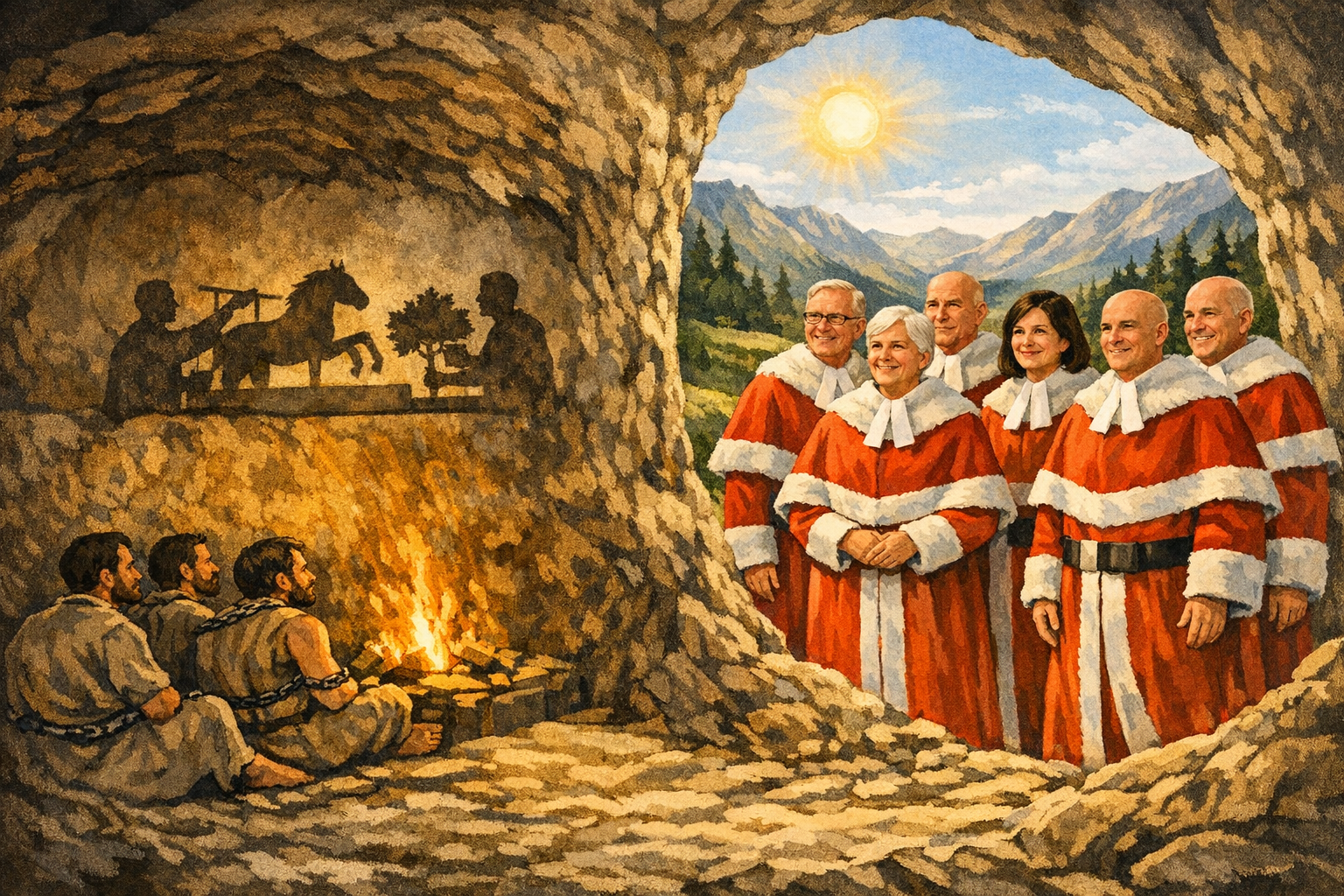
Taylor shows, however, that the Supreme Court’s pronouncements on constitutional interpretation, like on so much else, ultimately mean very little. Even individual judges, like Justice Côté, seemingly think nothing of signing onto opinions that taking very different approaches to interpretation; the court as a whole has even less regard for consistency. Meanwhile, Justice Martin has already announced her retirement. Justices Karakatsanis and Moreau will have retired five years from now — if they stick around to mandatory retirement — and Justice Rowe sooner than that. What will their replacements think about constitutional interpretation? Who knows? Who cares? Canadians apparently take pride in being oblivious to such matters. We’re just fine with being stuck down in Plato’s cave. I’d say we deserve better than Taylor from our Supreme Court, but… maybe we really don’t.

 Double Aspect
Leave a comment