Two weeks ago, I argued here that Adrian Vermeule did not deserve academic accolades because his intellectual project is not only authoritarian but directly antithetical to the virtues scholarship at its best is supposed to embody. I return to the issue because a recent post by Professor Vermeule at his Substack neatly illustrates both tendencies. In introducing a collection of posts devoted to driving a wedge between liberalism and the Rule of Law, Professor Vermeule both distorts the literature to suit his agenda and serves up yet another motte-and-bailey argument meant to excuse arbitrary rule.
Professor Vermeule’s target is the claim “that the rule of law is an achievement of liberalism”, which he attributes to unidentified “legal or philosophical liberals”. For Professor Vermeule, this
seems implausible on its face. For better or for worse, law, law codes, legal customs, law courts and legal judgments have been central features of the Western tradition at least since the Roman republic, long before anything faintly resembling the liberal tradition, or anti-tradition, came on the scene. …
In order to claim that the rule of law, rightly understood, is an achievement of liberalism, one would have to either claim that the greatest lawmakers and jurists of the tradition were deluded or mendacious, or else adopt an account of the rule of law that in effect begs the question by building liberalism into the definition itself (as when legality in any non-liberal version is classed, by sheer fiat, as “rule by law” rather than “rule of law.”)
It is, you will be shocked to hear, the liberals themselves who are deluded, or mendacious — or both:
What seems to have happened is a mental process that one sees in other domains as well: for the devout liberal, all good things are entailed by liberalism or entail liberalism or both, in a kind of Panglossian political theodicy. … So too with liberalism and the rule of law, which liberals hope to appropriate for themselves, against all evidence. Indeed, for the classical lawyer, the real question is not whether the rule of law can obtain in the absence of liberalism, for it obviously can. The real question is whether it can obtain in the presence of liberalism.
Bluntly, I do not think that any of this is said in good faith. Professor Vermeule knows that when we talk about the Rule of Law — and by “we” I mean any serious person who has written about it these past 150 years, from libertarians and whigs to, heaven help us, Marixsts — we do not mean the mere existence of “law, law codes, legal customs, law courts and legal judgments”. He knows because he does that himself. I am not a conoisseur of Professor Vermeule’s oeuvre, but I have read the book he has co-authored with Cass Sunstein, Law and Leviathan: Redeeming the Administrative State. The way the administrative state is supposed to be redeemed there, notably from the attack of scholars such as Richard Epstein and Philip Hamburger, is by showing that it complies with the account of the Rule of Law given by Lon Fuller, in The Morality of Law, which certainly goes beyond the mere existence of legal rules and courts.
Fuller’s account of the Rule of Law is probably the most famous one, but of course there are any number of others; just what the Rule of Law requires beyond the existence of the institutions mentioned by Professor Vermeule is a matter of considerable debate. I think it is fair to say that some, perhaps even many, (left-)liberal writers torque their definition of the Rule of Law in order to build their political preferences into it. This is the sort of thing Joseph Raz, very much a liberal himself, was denouncing in his famous article on “The Rule of Law and Its Virtue”. I also think the distinction between the Rule of Law and rule by law can be taken too far in the service of a substantive agenda. But there is no serious discussion of the Rule of Law that would accept that it is in place wherever something called law and something called courts exist. If nothing else, on Fuller’s view — which I think is fairly uncontroversial at least as a minimal set of Rule of Law requirements — the law must have a certain formal quality, so that it is known and intelligible in advance of its application, which in turn must be consistent with the law as stated.
And of course it is possible for “the greatest lawmakers and jurists” to have failed even at this deceptively low hurdle, whether because they were indeed mendacious or, simply, because they were not in fact trying to achieve the Rule of Law as we — and again, this is very much a cross-ideological “we” — have understood it in the last 150 years. The Roman jurists, to whose authority Professor Vermeule appeals above all, came to argue that “that which pleases the Emperor has the force of law”. That is inconsistent with any plausible account of the Rule of Law, because the Emperor’s pleasure is unknowable in advance of its expression (and perhaps unknowable to its targets even after its expression to, say, the Praetorians). Napoleon made himself the reputation of a great legislator, thanks to the Civil code that is commonly identified with his name, but the Duc d’Enghien, to name only the most famous case, would not have thought that the then-First Consul, who ordered his kidnapping outside French territory and pseudojudicial murder, gave a fig for the Rule of Law.
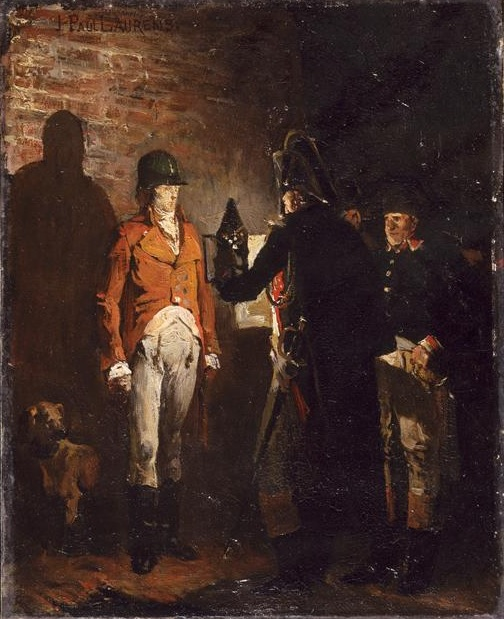
Professor Vermeule writes as if these and other such cases did not exist and indeed as if they were “implausible”. That is rubbish, and he knows this. Why does he do it? Perhaps his tyrannophilia is such that he is simply falling for the authoritarian propaganda that presents these regimes as something that they were not. More likely, I suspect, it’s just the ol’ motte-and-bailey. Motte: pre- or indeed anti-liberal regimes have law; sometimes, indeed, quite sophisticated legal systems which, in many ways, do meet Rule of Law requirements — until your actions, words, or, as with the Duc d’Enghien, mere existence, no longer please the ruler. Bailey: people who care about the rule of law needn’t worry about Professor Vermeule and his acolytes’ attacks on liberalism, because the stuff they really value can exist just as well without it; they should get comfortable with illiberal government, which will serve them better than the liberal sort. As usual, the motte is banal and the bailey is indefensible, and a serious scholar would not argue in this way. Professor Vermeule is not a serious scholar.
Indeed, of the ways in which Professor Vermeule is not only no model of scholarship but something like the opposite is his ability to sidetrack and render toxic discussions that would be worth having. That, as I explained here, is what he did when he chose to remind us of the costs of due process just when the Trump administration launched its campaign to deport people to torture gulags in El Salvador. So too with this issue. The relationship between the Rule of Law and liberalism is, indeed, not quite straightforward, and would be worth discussing. But not like this.
For what it’s worth, I’m inclined to think it would indeed be a mistake to see the Rule of Law as an achievement of liberalism. (Indeed, since Professor Vermeule does not deign to link or cite to anyone, I wonder whether many people take this view, though in fairness I wouldn’t be surprised if some do.) I do not think that liberalism comes first, and the rule of law later; historically, it is probably more accurate to say that they develop concurrently and reinforce one another. Professor Vermeule is scornful of this idea, just as he is scornful of the possibiltiy that a mutually-reinforcing relationship exists between liberalism and democracy, but examples of either the Rule of Law or democracy existing without liberalism are rare and unstable at best — and likely less committed to legality or democracy than their leaders might like us to think. I wouldn’t take the chance the Empire of Our Lady of Guadalupe, the Catholic integralist utopia Professor Vermeule dreams of, being the exception rather than the rule. The rule is that authoritarian government does not like the Rule of Law and does not subject itself to it.


Leave a comment