Last week, the Supreme Court released its judgment in Alford v Canada (Attorney General), 2026 SCC 14,1 holding 8-1 that legislative provisions that allow members of Parliament to be prosecuted for divulging certain national security information, including in Parliament, are not unconstitutional. I have no strong opinions on the merits of the provisions at issue. Nor am I all that interested in the merits of the case which, to anticipate, turn on the degree to which these provisions undermine, or do not undermine, Parliament’s role. What I am interested in is the constitutional interpretation aspect of the case. On this, there is no disagreement between Justice Côté, in dissent, and Justice Rowe, writing for the majority.
The provisions at issue are part of the National Security and Intelligence Committee of Parliamentarians Act. They explicitly withdraw the protection of Parliamentary privilege from the members or former members of the eponymous committee, should these members reveal secrets which they come across in the course of their work there. If the provisions are valid, then the freedom of speech and debate in Parliament, hallowed as it is, does not henceforth extend to the disclosure of the information to which they apply. But the argument against them is that Parliament was not entitled to limit its own privilege in this way.
Parliament’s power in relation to its privileges is set out in s 18 of the Constitution Act, 1867. This provides that
The privileges, immunities, and powers to be held, enjoyed, and exercised by the Senate and by the House of Commons, and by the members thereof respectively, shall be such as are from time to time defined by Act of the Parliament of Canada, but so that any Act of the Parliament of Canada defining such privileges, immunities, and powers shall not confer any privileges, immunities, or powers exceeding those at the passing of such Act held, enjoyed, and exercised by the Commons House of Parliament of the United Kingdom of Great Britain and Ireland, and by the members thereof.
There is, thus, an upper limit on the scope of privilege in Canada — subject of course to constitutional amendment — posed by the scope of the privilege claimed by the UK House of Commons at the point when the Parliament of Canada legislates on the matter. (Paradoxically, if the UK House of Commons then disclaims some part of its privilege, nothing needs to change in Canada — until the day the Parliament of Canada decides to update its legislation, at which point it must follow Westminster’s lead.) The issue in Alford, however, is whether there is also a lower limit implicit in s 18.
Justice Rowe’s statement of the principles of constitutional interpretation is fairly brief, and worth reproducing almost in full (keeping in mind that the Court is unanimous on this):
The interpretation of a constitutional provision must be anchored in the meaning of its words, considered in context, with a view to the purpose it was intended to serve”. … Constitutional documents must be read generously and purposively within their textual, contextual, and historical confines … The meaning given to a constitutional provision must also be harmonious with the structure of government implemented by the Constitution … The interpretation of a single provision must be consistent with other provisions of the Constitution: one part of the Constitution cannot be construed to deprive another of its effect. … The interpretive exercise is therefore guided and “constrained by the language, structure, and history of the constitutional text, by constitutional tradition, and by the history, traditions, and underlying philosophies” of the system of government these enactments are intended to establish (Reference re Public Service Employee Relations Act (Alta.),[1987] 1 SCR 313, at p. 394) [47-49]
This is a remarkable statement, both for what is there and for what isn’t.
To start with the latter: there is no reference here to the Supreme Court’s extensive recent discussion of constitutional interpretation in Taylor v Newfoundland and Labrador, 2026 SCC 5, which I summarized here and critiqued here. Nor is there any reference to cases such as R v Comeau, 2018 SCC 15, Quebec (Attorney General) v 9147-0732 Québec inc, 2020 SCC 32, or indeed any case on constitutional interpretation decided in the last 20 years. Nor yet is there a reference to Edwards v Attorney-General for Canada, [1930] AC 124 (PC) and to the “living tree” approach to interpretation which it supposedly stands for.
And it’s not just the references that are missing. More importantly, Justice Rowe’s entire approach is quite different from what the majority in Taylor outlined. Consider what he does say.
First: constitutional interpretation is anchored in the meaning of the words. Now where have we seen that metaphor before? Why, in a whole bunch of cases, starting with Quebec (Commission des droits de la personne et des droits de la jeunesse) v Directrice de la protection de la jeunesse du CISSS A, 2024 SCC 43, [24]; there is a list in co-blogger Mark Mancini’s forthcoming article conveniently called “‘Text as Anchor’ in Statutory Interpretation”. Except that Justice Rowe doesn’t cite these cases. I can’t get inside His Lordship’s head and tell you why, but there are two possibilities.
One: Justice Rowe is frightfully forgetful. He doesn’t remember these cases, just as perhaps he didn’t remember Commission scolaire francophone des Territoires du Nord-Ouest v Northwest Territories (Education, Culture and Employment), 2023 SCC 31 when he ignored it and took a very different approach six months later in York Region District School Board v Elementary Teachers’ Federation of Ontario, 2024 SCC 22. And his clerks are, year after year, delinquent and neglect to remind him.
Two: Justice Rowe isn’t forgetful. Oh no, he remembers the “text as anchor cases” perfectly well, just as he remembers Taylor. And he remembers that, in Taylor, the majority made a vigorous case for the proposition that — contrary to what the Supreme Court had strongly suggested in Comeau (on which, see here) — constitutional interpretation is nothing like the statutory sort. But Justice Rowe can’t be bothered to explain away his colleagues’ decisions with which he disagrees, or even to note his disagreement, and just pretends that these unpleasant things didn’t happen, so he just subtweets his colleagues instead.
And for their part they are apparently happy to let him. Justice Côté, who had written the CSFTNO decision, as well as three other judges who signed onto it, also signed on to York Region. Justices Karakatsanis and Martin, who wrote the majority opinion in Taylor, as well as Justices O’Bonsawin and Moreau, who joined it, also join Justice Rowe’s opinion in Alford; Justice Côté, who had joined the Taylor majority, agrees with his treatment of constitutional interpretation. They evidently don’t care about their recent precedents being followed, or so much as mentioned; they apparently don’t mind the subtweeting. Why would Justice Rowe not do it? While I’m at it, let me note that Justice Rowe’s discussion of privilege repeatedly cites not the majority opinion in the Supreme Court’s most recent consideration of this principle in Canada (Attorney General) v Power, 2024 SCC 26, nor indeed his own dissent, but Justice Jamal’s concurrence. As I explained in my posts on Power, I thought (and still think) it was by some distance the best of the three opinions (though imperfect), and if it becomes the “official story” of that case, so much the better. But of course one shouldn’t get one’s hopes up based on what precedents the Supreme Court does or does not cite.
Speaking of which, another thing to note in what Justice Rowe says is the citation to the PSERA Reference. It’s an almost-40 year-old case, whose holding was put under increasing pressure and then finally actually overruled — not merely ignored, the way Justice Rowe and his present colleagues tend to do! — in Saskatchewan Federation of Labour v Saskatchewan, 2015 SCC 4, though admittedly this hasn’t prevented it from being repeatedly cited at the Supreme Court. I’m afraid I lack the time and the inclination to see how it is being used in these other cases, but be that as it may, its constrained approach to constitutional interpretation is surely no stranger to its ratio, which was then rejected in SFL by a majority bent on giving “constitutional benediction” to new rights for organized labour. To cite it as authority on constitutional interpretation, without so much as mentioning all this, is bizarre.
In light of all this, it seems like a waste of time to be discussing the substance of Justice Rowe’s reasons. Briefly, for the record, Justice Rowe’s interpretation of s 18 is largely textualist, though of course he pays attention to the historical and legal context in which its words were enacted and the textual context in which they appear — as a good textualist ought to. Justice Rowe also addresses the “purpose” of s 18, but defines it — consistently with Quebec Inc and other cases that led to it, which I discuss in this article — in a manner that is essentially a tautology: “consistent with its text and context, the purpose of s. 18 is to allow Parliament to define the privileges, powers, and immunities it needs to protect its functions as a legislative body”. [68] Well yes, the purpose of a provision that allows Parliament to define its privileges is to allow Parliament to define its privileges. This does no further work in Justice Rowe’s opinion; the purpose of s 18 would only make a difference in hypothetical scenarios where Parliament tried “to effectively abolish parliamentary privilege as a whole” or “to fundamentally impair the ability of the Houses of Parliament to carry out their essential functions as deliberative law-making assemblies in which the executive is held to account”. [70] Justice Côté thinks that’s exactly what is going on, but if she is wrong about this, then the discussion of, and indeed reference to, purpose is as pointless as ever.
But really, it don’t mean a thing, with apologies to the Duke. The Supreme Court says one thing today, and will say another tomorrow, and a different one again the day after. When writing about York Region, I compared this way of doing things “to disappear[ing] [an] entire line of cases like a disgraced People’s Commissar from a Soviet photograph”. In one of my posts on Taylor I spoke of the Court pulling an “invisible rabbit out of its fool’s cap”. Reading Alford, I have thought of another image, faithfully produced here by ChatGPT:
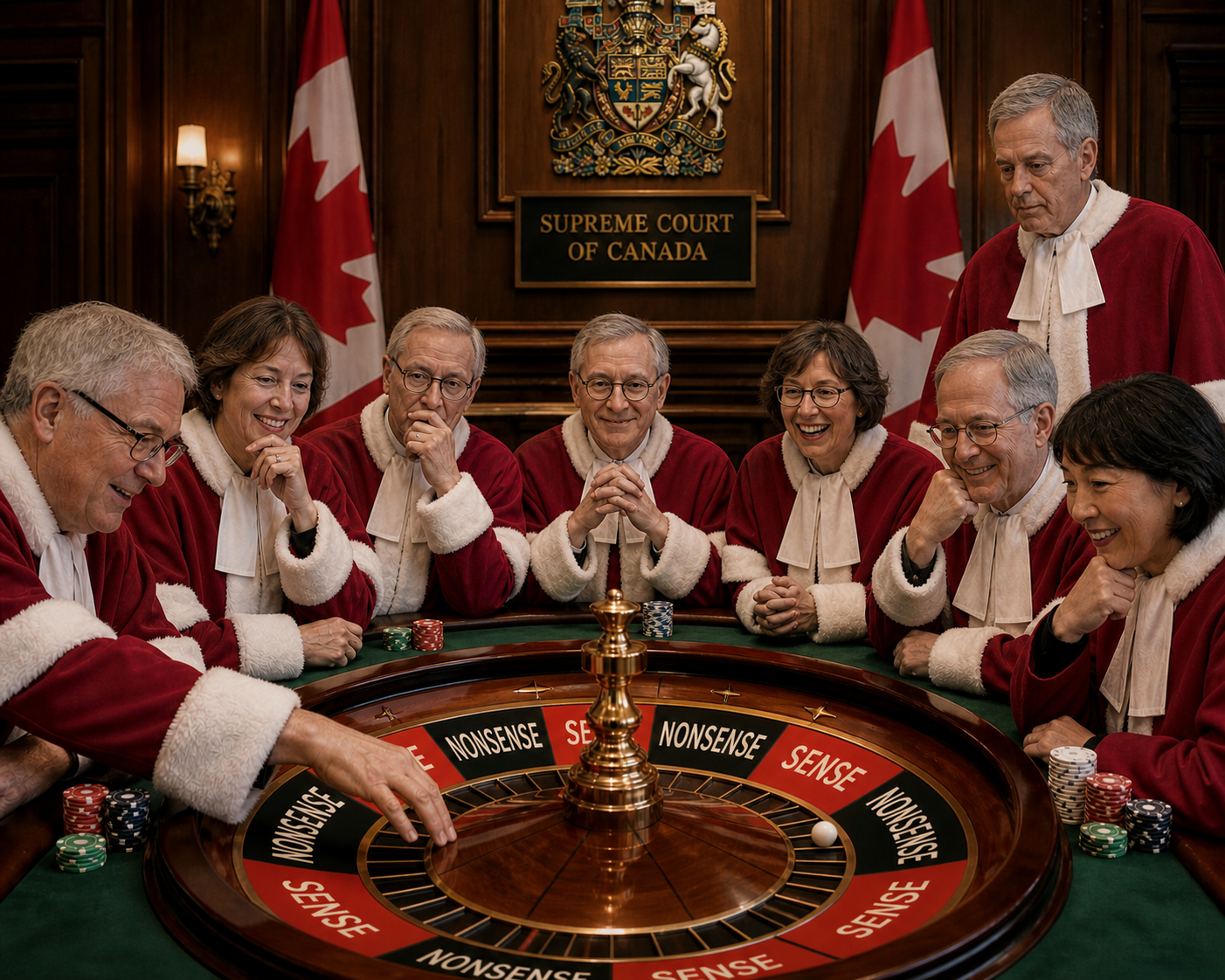
If it were considered in isolation, Alford could be seen as a comparatively sensible decision. But the point is that it should not be. The Supreme Court seemingly wants us to think of its cases as unrelated to one another, except insofar as its highly, or rather bizarrely, selective citations let on. But there is no reason to do that; indeed, decent lawyers must not do that. For those of us who can remember what the Court did last month, or even last year, Alford is only the latest instalment of an unseemly game of constitutional roulette. This time, the ball landed on sense, but it would be a mistake to make too much of it. The wheel will spin again, and the ball will land… somewhere. Probably somewhere else.
I have no time for the populist clowns demanding that Supreme Court judges be removed from office in case they dare make decisions that the clowns dislike. But it is difficult to be any more positive about a court that obstinately refuses to act like one. That would entail paying attention to precedent; not even necessarily to follow it — in any event it’s impossible to follow all the contradictory decisions the Supreme Court has produced in recent years — but to acknowledge its existence and put in the effort of separating the wheat from the chaff. It would entail, more broadly, being dedicated to legal doctrine, with all the complexities that such dedication can bring. It would entail, most fundamentally, being more interested in law than in vibes. There are one or two judges on the Supreme Court who are better at this than the others, but as an institution, the Court is an abject failure. This failure will not be corrected by replacing one lot of results-oriented judges by another, as the populists would do. But nor can it simply go unremarked upon, as polite Canadian consensus would normally have it.
- Full disclosure: the applicant, Professor Ryan Alford, is a friend. However, we have not discussed the case. ↩︎


Leave a comment